


 PLATFORM UPDATE:

Extraction, characterization and evaluation of jute (Corchorus olitorius) leaf polysaccharide as a binding agent for matrix tablet formulation

Abstract
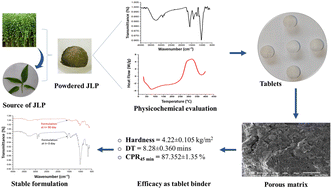
The objective of the present investigation was to estimate the potential of jute (Corchorus olitorius) leaf polysaccharide (JLP) as a tablet binder. This polysaccharide was extracted by a simple decoction method using distilled water and precipitated with twice the volume of acetone. The extracted JLP was dried, powdered and subjected to several characterizations, such as FTIR spectroscopy, DSC, XRD, scanning electron microscopy, zeta potential analysis, particle size analysis, tests for the presence of phytochemical constituents, elemental analysis, and stability study in an aqueous environment, along with characterizing other physicochemical properties. Diclofenac sodium-incorporated granules were prepared using 2.5%, 5%, 7.5% and 10% w/w JLP concentrations, and the prepared granules were evaluated and compressed into tablets. The formulated tablet batches were evaluated for disintegration, drug release and kinetics study. The obtained results were compared with those of similar concentrations of starch and PVP K-30 batches used as tablet binders. Results of FTIR spectroscopy and DSC study established the compatibility between JLP and diclofenac sodium (DS) in the formulation. SEM analysis indicated that drug release from the tablet matrix was predominantly controlled by surface erosion and pore development, which facilitated dissolution. JLP formulations revealed a drug release of >75% at 45 min (77.75% ± 1.298% to 87.352% ± 1.35%). The Korsmeyer–Peppas release exponent (n) from 0.56 to 0.84 indicated that the majority of batches exhibited anomalous (non-Fickian) transport, signifying that drug release was influenced by both diffusion and polymer relaxation or erosion. Preliminary study findings established JLP as a suitable pharmaceutical excipient. Even at 2.5% binder concentration, low friability (0.308% ± 0.057%), hardness (4.22 ± 0.105 kg m−2) and drug release pattern of the prepared tablets indicated the potential of the extracted novel JLP as a sustainable and safe alternative to conventional tablet binders.
 Please wait while we load your content...


