


 PLATFORM UPDATE:

Lung physiologically based pharmacokinetic modelling to predict sublingual buprenorphine kinetics following oral inhalation
 *a
Daniel Okwudili
Nnamani,
b
Elias Bestman
Adikwu
c
and
Chisom Anthony
Nnanna
d
*a
Daniel Okwudili
Nnamani,
b
Elias Bestman
Adikwu
c
and
Chisom Anthony
Nnanna
d
Abstract
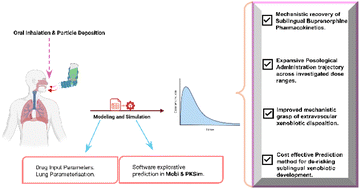
The pulmonary system embodies a heterogeneous yet highly efficient interface for xenobiotic uptake, offering unique translational opportunities for pharmacokinetic modelling. The sublingual route is widely exploited to deliver buprenorphine, a lipophilic partial μ-opioid receptor agonist, while circumventing gastrointestinal degradation and hepatic first-pass metabolism; however, the pharmacokinetics of buprenorphine are marked by pronounced nonlinearity and variability driven by mucosal residence time, dissolution, and involuntary swallowing. In the absence of a native sublingual absorption module within the Open Systems Pharmacology (OSP) ecosystem, this study investigated whether a mechanistically constrained inhalation physiologically based pharmacokinetic (PBPK) framework could serve as a defensible surrogate to recover sublingual buprenorphine kinetics. A human inhalation PBPK model incorporating a 24-generation lung architecture was implemented in MoBi and PK-Sim, integrating morphometric and physiological descriptors with the physicochemical parameters of buprenorphine. Particle deposition was deliberately biased toward the extrathoracic and proximal tracheobronchial regions by selecting reported metered-dose inhaler particle sizes (MMAD ≈ 7.5 µm), thereby emulating sublingual mucosal exposure. The model explicitly resolved particle deposition, epithelial lining fluid dissolution, permeability-limited epithelial transfer, mucociliary clearance–driven swallowing, and systemic distribution, preserving the causal structure. Systemic disposition was described using a two-compartment model, with key parameters estimated through Monte Carlo optimisation. Model performance was evaluated against single-ascending-dose clinical data (2–24 mg) and further verified using independent studies of sublingual tablets and solutions. Across all dose levels (2–24 mg), predicted Cmax and AUC metrics were recovered within predefined two-fold acceptance limits, with prediction accuracies generally ranging from 73% to 138% for AUC and 81% to 103% for Cmax. The model robustly reproduced early exposure and peak timing while systematically underpredicting the terminal half-life, consistent with the structural constraints of the systemic disposition model and the absence of explicit mucosal depot or enterohepatic recirculation processes. Sensitivity analysis identified particle dissolution dynamics and mucociliary clearance kinetics as dominant drivers of exposure. In conclusion, this work demonstrates that an open-source inhalation PBPK framework can mechanistically and quantitatively approximate sublingual buprenorphine pharmacokinetics. The approach provides a transparent, extensible surrogate for sublingual absorption, supporting translational modelling and hypothesis generation when route-specific modules are unavailable.
 Please wait while we load your content...


