The ideal duo for salt formation: vinpocetine and tosylic acid

Abstract

Two novel soluble salts of vinpocetine were prepared through simple and highly sustainable mechanochemical methods. Specifically, water-assisted grinding led to the formation of a crystalline, anhydrous, equimolar salt with p-toluenesulfonic acid, whereas neat grinding produced its amorphous counterpart. The structure of the crystalline salt was elucidated using single-crystal X-ray diffraction, while the ionic nature of the amorphous salt was confirmed by X-ray photoelectron spectroscopy. The large ΔpKa between p-toluenesulfonic acid and vinpocetine promotes the formation of a stable salt, with strong ionic interactions between the protonated tertiary amine of vinpocetine and the tosylate anion (as also attested by amorphous salt glass transition of about 81 °C). Both salts significantly enhance the saturation solubility of vinpocetine at 37 °C in phosphate buffer, achieving thermodynamic equilibrium in half the time compared to the pure crystalline drug. These findings highlight new opportunities for the development of vinpocetine, a compound with well-documented effects on cerebral circulation, whose broader application has so far been limited by its extremely low aqueous solubility.
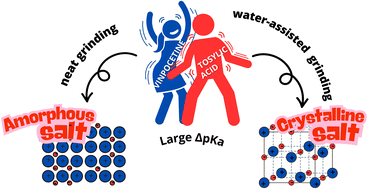
Graphical abstract: The ideal duo for salt formation: vinpocetine and tosylic acid

Supplementary files

Article information

Article type
Paper
Submitted
25 Aug 2025
Accepted
09 Oct 2025
First published
20 Oct 2025
This article is Open Access
Creative Commons BY-NC license

RSC Pharm., 2026, Advance Article

The ideal duo for salt formation: vinpocetine and tosylic acid

I. D'Abbrunzo, F. Beltrame, L. Gigli, N. Demitri, C. Cepek, F. Bassato, G. Procida, D. Voinovich and B. Perissutti, RSC Pharm., 2026, Advance Article , DOI: 10.1039/D5PM00225G

This article is licensed under a Creative Commons Attribution-NonCommercial 3.0 Unported Licence. You can use material from this article in other publications, without requesting further permission from the RSC, provided that the correct acknowledgement is given and it is not used for commercial purposes.

To request permission to reproduce material from this article in a commercial publication, please go to the Copyright Clearance Center request page.

If you are an author contributing to an RSC publication, you do not need to request permission provided correct acknowledgement is given.

If you are the author of this article, you do not need to request permission to reproduce figures and diagrams provided correct acknowledgement is given. If you want to reproduce the whole article in a third-party commercial publication (excluding your thesis/dissertation for which permission is not required) please go to the Copyright Clearance Center request page.

Read more about how to correctly acknowledge RSC content.

Social activity

Spotlight

Advertisements