


 PLATFORM UPDATE:

Enhancing the bioavailability of sparingly-soluble drugs by expandable, solid-solution fibrous dosage forms
 *ab
Henning
Richter
c
and
*ab
Henning
Richter
c
and
Abstract
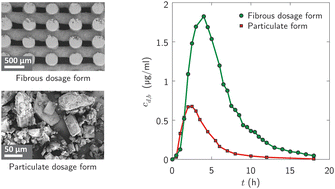
Many kinds of drug are sparingly soluble in the acidic gastric fluid, and are practically insoluble in the pH-neutral intestinal fluid. The efficacy of oral therapies employing such drugs is often limited by the amount of drug that can be delivered into the blood stream. For enhancing the amount delivered, in the present work an expandable, solid-solution fibrous dosage form is presented. The dosage form investigated was a cross-ply structure of fibers comprising 200 mg of the sparingly-soluble drug nilotinib molecularly dispersed in hydroxypropyl methylcellulose (HPMC)-based excipient. Upon administering to a dog, it expanded to a normalized radial expansion of 0.5 within an hour and resided in the stomach for about five hours. The drug concentration in blood rose to a maximum of 1.82 µg ml−1 by 4 hours, and decayed exponentially thereafter. The bioavailability (area under the drug concentration in blood versus time curve) was 10.81 µg h ml−1. For comparison, the maximum drug concentration of an immediate-release capsule filled with 200 mg crystalline nilotinib particles was 0.68 µg ml−1 by 2.5 hours. The bioavailability was 2.94 µg h ml−1, a third of that of the fibrous form. Models suggest that the greater bioavailability of the fibrous dosage form is due to increased gastric residence time and supersaturation of the gastric fluid with the drug.
 Please wait while we load your content...


