


 PLATFORM UPDATE:

Improved localized mRNA delivery using lipid nanoparticles with a novel synthetic cholesterol derivative

Abstract
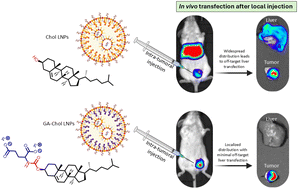
Lipid nanoparticles (LNPs) are self-assembled nanocarriers made up of ionizable cationic lipids, membrane lipids, sterols, and PEGylated lipids in a predetermined proportion to encapsulate nucleic acid payloads. According to recent findings, following local administration (intramuscular, intratumoral), LNPs diffuse into the systemic circulation and subsequently show liver transfection. Liver transfection can result in both liver toxicity and undesirable cargo distribution. To address this issue, we synthesized a novel cholesterol derivative, glutamate–cholesterol (GA–Chol), which, when incorporated in LNPs (GA–Chol LNPs), improved in vitro transfection efficiency by approximately 10-fold and 20-fold in HEK293T and HeLa cells, respectively. Furthermore, when GA–Chol LNPs were injected intramuscularly or intratumorally, robust localized transfection was observed in either the injected muscle or the flank tumors, without significant transfection in the liver. This observation was consistent across multiple cell lines, representing various types of cancer. Leverage local delivery strategy, mRNA encoding for constitutively active caspase-3 was encapsulated with GA–Chol LNPs and delivered intratumorally in 4T1 tumor-bearing BALB/c mice, resulting in a significantly reduced and sustained tumor burden. Overall, these findings describe the potential application of a synthetic cholesterol derivative for the localized transfection of LNPs.
 Please wait while we load your content...


