


 PLATFORM UPDATE:

Spray-dried inhalable nano-embedded microparticles of isoniazid and pyridoxine hydrochloride for pulmonary tuberculosis

Abstract
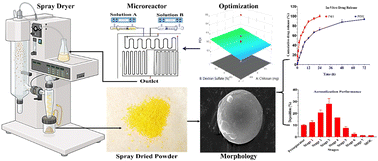
Tuberculosis (TB) is the second deadliest communicable disease caused by Mycobacterium tuberculosis and mainly affects the lungs. Current TB therapy typically involves the oral administration of antitubercular drugs (ATDs). However, this approach is often associated with challenges, such as drug toxicity, suboptimal pulmonary drug concentration, and issues with patient adherence. Moreover, isoniazid (INH) therapy frequently induces pyridoxine (PDX) deficiency in TB patients, potentially leading to neuropathy. In this study, INH–PDX nano-embedded microparticles (NEMs) were developed as a dry powder formulation to enhance pulmonary TB treatment. The formulation was optimised using a microreactor through a three-factor, three-level Box–Behnken design (BBD). The optimised dry powder achieved a product yield of 48.36% (w/w) and a drug-loading efficiency of 24.14 ± 2.86% (w/w). The particles exhibited a spherical morphology. Furthermore, aerosolization performance demonstrated the formulation's suitability for deep lung deposition, with a mass median aerodynamic diameter (MMAD) of 5.97 ± 1.10 µm, a fine particle fraction (FPF) of 36.63 ± 3.12%, and a geometric standard deviation (GSD) of 1.73 ± 0.23. In conclusion, the Design of Experiments (DoE)-based optimisation approach successfully optimised the process parameters and produced a dry powder formulation suitable for pulmonary delivery in patients with TB, addressing both treatment efficacy and neuropathy concerns.
 Please wait while we load your content...


