Photocatalytic C–H amination of electron-rich arenes by novel fused quinoline-based photocatalysts

Abstract

A modular synthesis of novel fused quinoline-based photocatalysts via the Povarov reaction was developed by employing aromatic amines, aromatic aldehydes, and acenaphthylene as raw materials. The catalyst can be protonated in the presence of HBF4 to generate a highly active photocatalytic species (PC) in situ, resulting in an excited-state reduction potential of +2.31 V. Under 450 nm visible-light irradiation, this system can smoothly catalyze the C(sp2)–H amination of electron-rich arenes with azoles and exhibits good regioselectivity for a set of substrates.
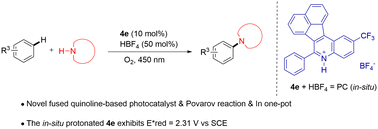
Graphical abstract: Photocatalytic C–H amination of electron-rich arenes by novel fused quinoline-based photocatalysts

Supplementary files

Article information

Article type
Paper
Submitted
14 Feb 2026
Accepted
23 Mar 2026
First published
31 Mar 2026

Org. Biomol. Chem., 2026, Advance Article

Photocatalytic C–H amination of electron-rich arenes by novel fused quinoline-based photocatalysts

Q. Shu, D. Li, S. Zheng, X. Lu, B. Sun and F. Zhang, Org. Biomol. Chem., 2026, Advance Article , DOI: 10.1039/D6OB00270F

To request permission to reproduce material from this article, please go to the Copyright Clearance Center request page.

If you are an author contributing to an RSC publication, you do not need to request permission provided correct acknowledgement is given.

If you are the author of this article, you do not need to request permission to reproduce figures and diagrams provided correct acknowledgement is given. If you want to reproduce the whole article in a third-party publication (excluding your thesis/dissertation for which permission is not required) please go to the Copyright Clearance Center request page.

Read more about how to correctly acknowledge RSC content.

Social activity

Spotlight

Advertisements