Construction of a 2H-1,4-selenazin-3(4H)-one framework via cyclization of pyrazole derivatives bearing chloroacetamide and selenocyanate fragments

Abstract

For the first time, we developed an efficient three-step method for the synthesis of substituted 1,7-dihydropyrazolo[4,3-b][1,4]selenazin-6(5H)-ones starting from readily accessible 5-aminopyrazoles. The presented approach is based on preliminary preparation of chloroacetamide derivatives followed by selenocyanation of the pyrazole ring and final reductive cyclization. The key selenocyanation stage includes the employment of commercially available SeO2 and malononitrile for the generation of triselenium dicyanide in situ in a simple setup under open-air conditions. The elaborated general protocol allowed us to obtain a set of final pyrazoloselenazinones with yields up to 88%. 77Se NMR-monitoring was applied for a detailed investigation of selenocyanation and intramolecular cyclization steps. Mechanistic studies showed that the conclusive reductive stage proceeds through the corresponding diselenide intermediate.
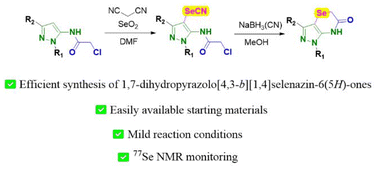
Graphical abstract: Construction of a 2H-1,4-selenazin-3(4H)-one framework via cyclization of pyrazole derivatives bearing chloroacetamide and selenocyanate fragments

Supplementary files

Transparent peer review

To support increased transparency, we offer authors the option to publish the peer review history alongside their article.

View this article’s peer review history

Article information

Article type
Paper
Submitted
13 Feb 2026
Accepted
09 Apr 2026
First published
14 Apr 2026

Org. Biomol. Chem., 2026, Advance Article

Construction of a 2H-1,4-selenazin-3(4H)-one framework via cyclization of pyrazole derivatives bearing chloroacetamide and selenocyanate fragments

T. A. Kudryavtseva, E. N. Kudryavtseva and B. V. Lichitsky, Org. Biomol. Chem., 2026, Advance Article , DOI: 10.1039/D6OB00263C

To request permission to reproduce material from this article, please go to the Copyright Clearance Center request page.

If you are an author contributing to an RSC publication, you do not need to request permission provided correct acknowledgement is given.

If you are the author of this article, you do not need to request permission to reproduce figures and diagrams provided correct acknowledgement is given. If you want to reproduce the whole article in a third-party publication (excluding your thesis/dissertation for which permission is not required) please go to the Copyright Clearance Center request page.

Read more about how to correctly acknowledge RSC content.

Social activity

Spotlight

Advertisements