


 PLATFORM UPDATE:


A β-hairpin mimic built on a fluorinated isoxazoline-β2,2-amino acid as a modulator of Tau protein aggregation

Abstract
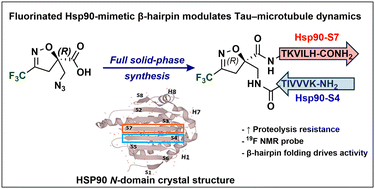
Alzheimer's disease (AD), the leading cause of dementia, is a tauopathy characterized by the intraneuronal accumulation of misfolded Tau into neurofibrillary tangles that drive synaptic dysfunction and neuronal loss. Molecular chaperones such as Hsp90 regulate Tau folding, degradation, and aggregation, but full-length chaperones are not viable drugs, prompting the development of peptidomimetics that reproduce protective Hsp90−Tau contacts. We previously reported two β-hairpin peptidomimetics derived from Hsp90, based on a piperidine–pyrrolidine (β-HM1) or on an isoxazoline amino acid (β-HM2) incorporating key hot-spot sequences, that inhibit the aggregation of wild-type and ΔK280 Tau and restore Tau–microtubule interactions in cells. Here, we describe the design and characterization of fluorinated β-HM2 analogues (β-FH1 and β-FH2) as molecular tools to investigate the mechanism of Tau misfolding. β-FH1 and β-FH2 contain a fluorinated isoxazoline-β2,2-amino acid scaffold whose S or R stereochemistry biases the peptidomimetic toward either a fully extended β-strand-like conformation or a β-hairpin fold, respectively. The replacement of the phenyl group of the Isox-β2,2-AA core by a trifluoromethyl substituent was intended to refine Tau anti-aggregation activity, enhance metabolic stability toward proteolysis, and introduce a sensitive 19F NMR probe to monitor Tau–peptidomimetic interactions at the molecular level. The fluorinated analogues completely lost their ability to prevent Tau aggregation in model neurons but caused increased dynamics of the Tau–microtubule interaction. This suggests that subtle changes in β-hairpin preorganization and flexibility impair optimal Tau recognition and affect Tau function in neuronal cell processes. These findings underline the need for finely tuned hairpin architectures in the design of chaperone-mimetic peptides.
 Please wait while we load your content...


