


Asymmetric hydrogenation of N-heterocycles for pharmaceutical intermediates: synthetic strategies and theoretical perspectives
 f
Heechae
Choi
*a
f
Heechae
Choi
*a
Abstract
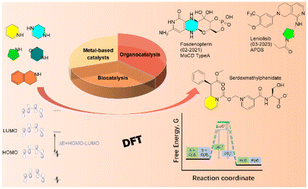
Nitrogen-containing heterocycles are pivotal in modern drug discovery, constituting a significant proportion of newly approved small-molecule drugs. However, the asymmetric catalytic hydrogenation (ACH) of these substrates remains challenging due to their high aromatic stability and the propensity of basic nitrogen atoms to deactivate catalysts. This review systematically summarizes recent advances in overcoming these hurdles for five key nitrogen heterocycles: pyridine, pyrrole, pyrazole, piperidine, and quinoline. We provide a comparative analysis of the three primary catalytic strategies: transition-metal complexes (e.g., Rh, Pd, and Ir), which offer the broadest substrate scope and high turnover numbers; organocatalytic systems, which provide environmentally benign alternatives for specific substrates; and biocatalytic approaches, which demonstrate exquisite selectivity under mild conditions. A distinguishing feature of this review is the integration of mechanistic rationalizations derived from Density Functional Theory (DFT) calculations. Rather than treating theoretical studies as a separate topic, we highlight how atomic-scale modeling clarifies critical factors governing stereocontrol that are often inaccessible via experiment alone. Specifically, we discuss theoretical insights into (1) the thermodynamic competition between substrate adsorption and hydrogen evolution on metal surfaces, (2) the origins of solvent-induced enantiodivergence via explicit solvent-bridged transition states, and (3) the determination of stereodetermining steps (e.g., enamine protonation vs. hydride transfer) in organocatalysis. By bridging empirical synthetic results with these theoretical insights, this work aims to provide a comprehensive guide for selecting appropriate catalytic systems and facilitating the rational design of next-generation catalysts for high-value chiral heterocycles.
 Please wait while we load your content...


