


 PLATFORM UPDATE:

Anion recognition in water by a simple bis-squaramide with charge-enhanced acidity
 *ad
*ad
Abstract
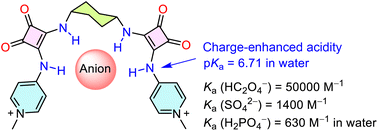
Synthetic anion receptors that function in water are typically elaborately designed macrocycles and cages, as a high level of pre-organisation is required to overcome the free energy cost from anion desolvation. The low yields and the use of dilute conditions associated with the synthesis of macrocycle/cage-based anion receptors limit their large-quantity production for industrial applications. We here develop a simple non-macrocyclic bis-squaramide anion receptor accessible in three synthetic steps. Pre-organisation afforded by a cis-1,4-diaminocyclohexane scaffold combined with potent cationic squaramide hydrogen bonding sites (the most acidic site with a pKa of 6.71 in water) delivers effective anion binding that tolerates aqueous conditions. The receptor is shown to bind hydrophilic, charge-dense anions such as hydrogenoxalate, sulfate, and dihydrogen phosphate with micromolar to millimolar affinities in water. In addition, ATP but not ADP or AMP induces dimerisation of the receptor, demonstrating the potential to develop biomimetic ATP-driven molecular machines based on the cyclohexane bis-squaramide scaffold.
- This article is part of the themed collection: New Talent 2025
 Please wait while we load your content...


