


 PLATFORM UPDATE:

Synthesis and evaluation of carbagalactosyl 1,2-aziridines and -epoxides as glycosidase inhibitors

Abstract
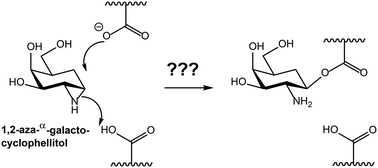
The natural product cyclophellitol is a cyclitol epoxide that mimics a β-glucoside and functions as a mechanism-based inhibitor for retaining β-glucosidases by forming a stable covalent intermediate with the enzyme's catalytic nucleophile. The epoxide is located across the carbons equivalent to C1 and O5 of glucose, and multiple congeners have been synthesised, as well as the corresponding aziridines, and shown to inactivate their cognate glycosidases. In a quest for a potent covalent inactivator of an α-galactosaminidase that is used in the conversion of A type blood to O type through modification of the antigen, we synthesised the galacto-configured 1,2-α-aziridine in which the aziridine ring is located across the carbons equivalent to C1 and C2. While neither this nor the corresponding epoxide inactivated our enzyme or any of the α-galactosidases tested, the β-configured analogues were shown by mass spectrometry to function as covalent inactivators of several β-glycosidases and their inactivation behaviour characterised kinetically. Molecular modeling indicates that 1,2-α-aziridines adopt an unfavorable conformation in solution, preventing binding to the enzyme active site. The synthesis of these compounds and their activities as inhibitors and inactivators of glycosidases of different families will direct future attempts to develop inactivators beyond those of the more common cyclophellitol class.
 Please wait while we load your content...


