


 PLATFORM UPDATE:


Sustainable and green approaches for Knoevenagel condensation
 *a
*a
Abstract
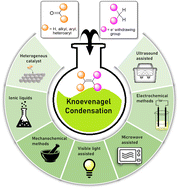
The Knoevenagel condensation reaction is one of the important and versatile transformations used to prepare a wide range of organic compounds bearing carbon–carbon double bonds. Therefore, it has widespread applications in organic synthesis, especially in the construction of a variety of biologically active heterocycles, natural products, and some important polymers. Over the past 130 years, numerous approaches have been developed for this reaction; however, many of these conventional methods are associated with drawbacks, such as harsh reaction conditions, the use of hazardous volatile solvents, tedious work-up, and waste generation. In light of the significance of Knoevenagel condensation and advancements in green chemistry, many greener and economically viable approaches have emerged in the past decades, encompassing the use of heterogeneous catalysts, green solvents, ionic liquids, metal–organic frameworks (MOFs), microwave, visible light, and electrochemical and ultrasound-assisted techniques. This review summarizes the recent developments in greener synthetic approaches for Knoevenagel condensation, with an emphasis on sustainable, efficient, and environmentally benign strategies.
 Please wait while we load your content...


