Electrochemically-generated ferricyanide enables thiol–ene capture of protein–protein binding

Abstract

Due to its efficiency, selectivity and biocompatibility, the thiol–ene coupling has demonstrated its potential for protein labelling. Here, we report the electrochemical thiol–ene activation to capture protein–protein binding events. In situ electrochemical generation of Fe(III) was used as the first example of an electrochemically generated thiol–ene protein–protein labelling reaction.
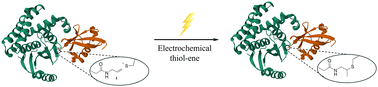
Graphical abstract: Electrochemically-generated ferricyanide enables thiol–ene capture of protein–protein binding

Supplementary files

Article information

Article type
Communication
Submitted
03 Nov 2025
Accepted
25 Nov 2025
First published
26 Nov 2025
This article is Open Access
Creative Commons BY license

Org. Biomol. Chem., 2026, Advance Article

Electrochemically-generated ferricyanide enables thiol–ene capture of protein–protein binding

A. Campaniço, D. Sommer, C. Batchelor-McAuley and J. F. McGouran, Org. Biomol. Chem., 2026, Advance Article , DOI: 10.1039/D5OB01728A

This article is licensed under a Creative Commons Attribution 3.0 Unported Licence. You can use material from this article in other publications without requesting further permissions from the RSC, provided that the correct acknowledgement is given.

Read more about how to correctly acknowledge RSC content.

Social activity

Spotlight

Advertisements