Chemoselective reduction of α-keto aldehydes by rongalite in water: a metal- and hydride-free approach

Abstract

A chemoselective reduction of α-keto aldehydes using rongalite in water has been developed for the efficient synthesis of α-hydroxymethyl ketones. This transformation exploits the unique reactivity of rongalite to achieve a mild, metal- and hydride-free reduction that proceeds smoothly in the presence of various functional groups. The protocol employs inexpensive rongalite (ca. $0.03 per gram), operates in an aqueous medium under open-air conditions, and requires no inert atmosphere. The reaction is readily scalable to gram quantities and exhibits excellent chemoselectivity and broad substrate scope, tolerating electron-donating, electron-withdrawing, and halogen substituents, as well as hetero aromatics, delivering the desired products in high yields within short reaction times.
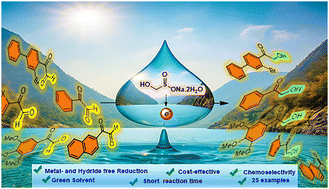
Graphical abstract: Chemoselective reduction of α-keto aldehydes by rongalite in water: a metal- and hydride-free approach

Supplementary files

Article information

Article type
Paper
Submitted
21 Oct 2025
Accepted
18 Nov 2025
First published
19 Nov 2025
This article is Open Access
Creative Commons BY-NC license

Org. Biomol. Chem., 2026, Advance Article

Chemoselective reduction of α-keto aldehydes by rongalite in water: a metal- and hydride-free approach

M. Inapanuri, H. P. Kokatla, R. Kandukuri and N. Singh, Org. Biomol. Chem., 2026, Advance Article , DOI: 10.1039/D5OB01653C

This article is licensed under a Creative Commons Attribution-NonCommercial 3.0 Unported Licence. You can use material from this article in other publications, without requesting further permission from the RSC, provided that the correct acknowledgement is given and it is not used for commercial purposes.

To request permission to reproduce material from this article in a commercial publication, please go to the Copyright Clearance Center request page.

If you are an author contributing to an RSC publication, you do not need to request permission provided correct acknowledgement is given.

If you are the author of this article, you do not need to request permission to reproduce figures and diagrams provided correct acknowledgement is given. If you want to reproduce the whole article in a third-party commercial publication (excluding your thesis/dissertation for which permission is not required) please go to the Copyright Clearance Center request page.

Read more about how to correctly acknowledge RSC content.

Social activity

Spotlight

Advertisements