


 PLATFORM UPDATE:


Nitrones as directing groups in transition metal-catalysed C–H activation
 *a
*a
Abstract
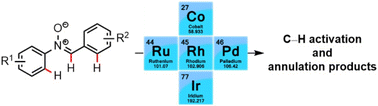
During about the last 15 years, nitrones have emerged as versatile directing groups for transition metal-catalysed C–H activation reactions. Apart from simple functionalization of the aryl ring attached to the nitrone moiety, the nitrone functional group can play the role of a transient directing group or an internal oxidant, allowing for the design of redox-neutral reactions initiated by a C–H activation step. Moreover, the dipolar character of nitrones has been exploited in cascade reactions involving C–H activation followed by 1,3-dipolar cycloaddition, resulting in the incorporation of the nitrone moiety into the structure of polycyclic, nitrogen-containing scaffolds found in biologically active compounds like aminoalcohols, indoles, carbazoles, quinolines, etc. Reactions of all of the above types, as well as the C(sp2)–H functionalization of the aldonitrone moiety itself, are the focus of this review. Apart from the already well-developed Rh, Ru and Pd-catalysed reactions, emerging applications of cobalt catalysis for nitrone functionalisation are discussed as well. Catalytic reactions of isoelectronic azomethine imines are also mentioned in connection with analogous reactions of nitrones.
- This article is part of the themed collection: Organic & Biomolecular Chemistry: Editor’s Choice Collection
 Please wait while we load your content...


