


 PLATFORM UPDATE:


Heterocyclic scaffold-fused dimethoxy-dibenzocyclooctynes for photoactivatable click chemistry

Abstract
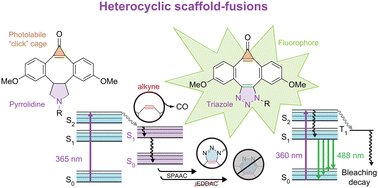
Dibenzocyclooctynes (DBCOs) are widely used in bioorthogonal chemistry for strain-promoted azide–alkyne cycloaddition (SPAAC), but generally lack reactivity toward inverse-electron-demand Diels–Alder cycloaddition (iEDDAC) with tetrazines. While photoactivatable DBCOs for SPAAC are well established and photoresponsive cyclooctynes for iEDDAC have recently been reported, photoactivatable DBCOs designed for dual reactivity remain scarce. Motivated by the possibility that heterocyclic fusions could tune reactivity and introduce new photochemical properties, we developed a modular synthetic route to a previously inaccessible heterocycle-fused DBCO. Upon photoactivation, the pyrrolidine fusions efficiently released the alkyne from the cyclopropenone cage, exhibiting strong SPAAC reactivity but, contrary to computational predictions, showing no detectable reactivity with tetrazines in iEDDAC. By contrast, triazole fusions, previously described as fluorogenic dibenzocyclooctyne (FL-DIBO), have not been evaluated in photo-click chemistry. We found that the cyclopropenone cage is essential for fluorescence, and its decarbonylation produced non-alkyne byproducts with no functional reactivity. This work expands the chemical space of DBCOs and establishes pyrrolidine-fused derivatives as the first functional heterocyclic-fused photoactivatable alkyne within the dimethoxy-DBCO scaffold class.
- This article is part of the themed collection: Articles behind our 2026 journal covers
 Please wait while we load your content...


