


 PLATFORM UPDATE:


A built-in electric field induces a high-performance hydrogen evolution reaction on a self-supporting MoO2-NiP/NF heterojunction
 c
Yujin
Chen
*a
c
Yujin
Chen
*a
Abstract
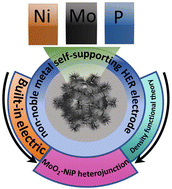
The development of non-noble metal electrodes, which possess catalytic activity comparable to that of Pt-based catalysts and exhibit excellent stability, remains the key to the large-scale commercial application of the hydrogen evolution reaction (HER). Here, we construct a self-supported electrode via in situ growth of sea urchin-like MoO2-NiP heterojunctions on three-dimensional nickel foam. The resulting electrode delivers outstanding HER performance in 1 M KOH, achieving an overpotential as low as 19 mV at 10 mA cm−2 and a Tafel slope of 22.18 mV dec−1. It also demonstrates exceptional long-term stability, retaining nearly unchanged activity after 400 h of continuous operation at 100 mA cm−2. A heterojunction with a built-in electric field directed from NiP to MoO2 is constructed to facilitate charge transfer, and density functional theory (DFT) calculations reveal that P sites primarily promote water adsorption while Mo sites serve as optimal centers for hydrogen intermediates, thereby synergistically optimizing the alkaline hydrogen evolution reaction pathway. This work proposes a feasible interfacial and structural synergy strategy for designing highly efficient and durable non-noble metal self-supported HER electrodes.
 Please wait while we load your content...


