


 PLATFORM UPDATE:


Electroreduction of carbon dioxide (CO2) at oxalate and polypyrrole modified copper surfaces
 *a
and
Sujat
Sen
*b
*a
and
Sujat
Sen
*b
Abstract
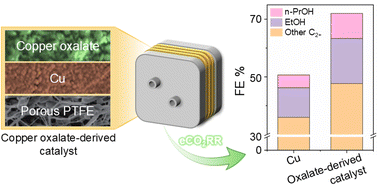
The electrochemical conversion of CO2 into useful chemicals remains an active area of investigation, especially towards higher order C2 and C3 products such as ethylene, ethanol and n-propanol. Herein, we demonstrate that oxalate modified copper surfaces on porous gas-diffusion electrodes (GDEs) can be used to modify the selectivity of the electrochemical CO2 reduction reaction (eCO2RR) towards higher order chemicals using a flow-type electrochemical cell at near-neutral pH and industrially viable current densities. These multi-layer composite cathodes consisting of a Teflon substrate, coated with copper, and then modified with copper oxalate exhibit up to 79% selectivity to C2+ products at varying current densities ranging from 50 up to 250 mA cm−2, representing a shift in electrocatalytic behavior as compared to the pristine copper/Teflon cathode. The oxalate modified copper surface enables further modification with a conductive polymer such as polypyrrole, tunable to varying thicknesses, demonstrating the feasibility of performing oxidative electropolymerization on copper-based GDEs and subsequently using them for the eCO2RR. We also investigate the changes occurring in these electrodes with respect to particle/grain size, morphology and surface chemistry using SEM, XRD and XPS.
 Please wait while we load your content...


