


 PLATFORM UPDATE:


Kinetic-dimension-enabled hydrogen sensing via spillover in oriented conductive polymer fiber networks

Abstract
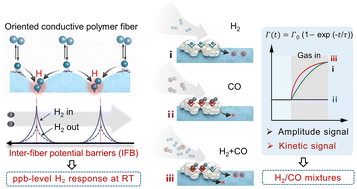
Hydrogen purity monitoring is essential for safe hydrogen utilization, yet quantifying trace carbon monoxide (CO) remains extremely challenging because CO produces adsorption behavior and signal amplitudes nearly indistinguishable from H2 on conventional chemiresistive sensors. Here, we report a Pt-decorated, highly oriented PEDOT:PSS/PEO fiber network in which inter-fiber potential barriers (IFB) dominate charge transport and hydrogen spillover enables a kinetic-dimension-based sensing mechanism. The oriented structure generates abundant IFB that are highly responsive to spillover hydrogen, enabling ppb-level H2 detection at room temperature. Importantly, CO is electronically silent toward IFB modulation while being chemically active at Pt sites. Through catalytic-site competition, CO selectively alters the effective H2 activation and spillover kinetics, thereby modulating the saturation time constant τ under fixed H2 concentration. By integrating τ as a kinetics-encoded signal dimension alongside amplitude, we quantitatively resolve CO content in H2/CO mixtures even when amplitude alone offers no discriminating power. This work establishes a materials strategy for spillover-activated polymer sensors and, more broadly, introduces a generalizable framework for kinetic-dimension-enabled chemiresistive sensing.
 Please wait while we load your content...


