


 PLATFORM UPDATE:


Enhanced performance of single-crystal perovskite solar cells via in situ passivation of ionic liquid
 *a
*a
Abstract
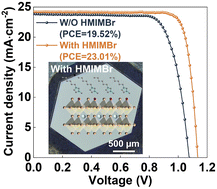
Metal halide perovskite single-crystal thin films (SCTFs) are recognized as promising light absorbers for solar cells due to their advantages of low bulk defect density, high thermal stability, and outstanding optoelectronic properties. However, their uncontrollable surface defects still pose a challenge. Widely used post-treatment strategies can passivate defects but these come at the cost of undesired damage at the buried interfaces, which results in the failure of devices. Herein, we propose an in situ passivation strategy by introducing an ionic liquid, 1-hexyl-3-methylimidazolium bromide (HMIMBr), during SCTF growth to passivate surface defects. Meanwhile, the HMIM+ cations with long alkyl chains form a hydrophobic protection barrier that suppresses corrosion induced by residual precursor solution, moisture permeation, and interfacial ion accumulation. The resultant SCTF solar cells with HMIMBr incorporation achieve an enhanced efficiency of over 23%, accompanied by significantly improved ambient stability. This in situ passivation strategy provides a simple yet effective approach for high-quality SCTFs and high-performance solar cells.
 Please wait while we load your content...


