


 PLATFORM UPDATE:


The water, of course! Impurity-induced polymorphism in the self-assembly of interfacial trimesic acid monolayers
 c
and
Markus
Lackinger
*ab
c
and
Markus
Lackinger
*ab
Abstract
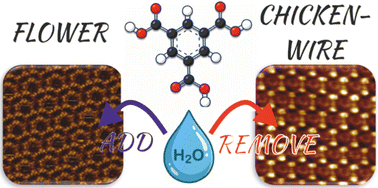
The self-assembly of supramolecular monolayers at liquid–solid interfaces has been extensively studied over the last three decades, predominantly by Scanning Tunneling Microscopy. Early on, evidence accumulated that polymorphism—the formation of different monolayer structures from the same molecular building block—is relatively common. A plethora of studies have demonstrated that the specific polymorph expressed can depend systematically and reliably on the type of solvent, solute concentration, temperature, and substrate used. By contrast, spontaneous polymorphism was also observed, whereby different polymorphs emerged under seemingly similar conditions. Although this phenomenon has been known for a long time also in the context of molecular bulk crystals, it is often poorly understood. Here, the self-assembly of hydrogen-bonded trimesic acid monolayers on graphite from heptanoic acid solution yielded either the chickenwire or the flower polymorph, depending on the batch and supplier of the solvent. In a previous study, however, we found the chickenwire polymorph to be most thermodynamically stable in this solvent. This unexpected spontaneous polymorphism was eventually attributed to water impurities in the heptanoic acid solvent, and could be controlled by adding or removing small amounts of water. We anticipate that a fuller and quantitative understanding of the water influence on polymorph selection in hydrogen-bonded monolayers could become a powerful lever for crystal engineering.
 Please wait while we load your content...


