


Nanoscale thermocapillary flow as a recording medium for infrared absorption spectra of individual carbon nanotubes

Abstract
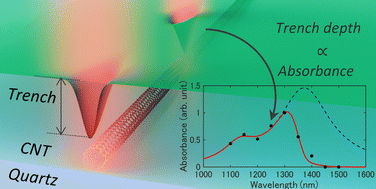
Thermally induced deformations of polymer thin films are fundamental to high-resolution thermal lithography and thermal property characterization. Among various heating methods, laser-induced thermocapillary flows convert nanoscale localized heating into surface deformation, providing a non-contact strategy for the selective removal of metallic carbon nanotubes (CNTs). Although chirality-dependent optical responses can be exploited for bandgap-selective removal of CNTs, detailed optical spectra of CNTs supported on substrates remain difficult to obtain because of their extremely small volumes and pronounced environmental influences, including doping and dielectric screening. Here, we utilize laser-induced nanoscale thermocapillary flows as a photothermal probe to visualize the near-infrared absorption response of an individual CNT on a substrate. The CNT is irradiated with a wavelength-tunable near-infrared laser (1100–1500 nm), and the wavelength dependence of the resulting trench depth in the polymer film is analysed to extract the optical response recorded in the thin film. The measured trench profile exhibits an unexpected reduction in the photothermal response above 1400 nm. We demonstrate that this behaviour does not directly represent the intrinsic absorption spectrum of the CNT. Thermofluidic simulations that incorporate the temperature dependence of polymer viscosity reveal a nonlinear amplification of trench formation under pulsed heating. After accounting for these nonlinear effects, spectral features corresponding to the exciton state and phonon sidebands are reconstructed. These findings establish thermocapillary deformations as a quantitative nanoscale photothermal spectroscopy method and provide a framework for evaluating environment-dependent optical spectra, with implications for chirality-selective CNT processing as well as high-resolution and rapid thermal patterning.
 Please wait while we load your content...


