


 PLATFORM UPDATE:


Titanium diboride–derived nanosheet coatings for enhanced condensation heat transfer

Abstract
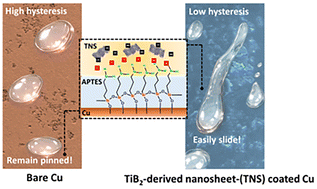
AlB2-type layered metal diborides have recently garnered renewed attention due to their ability to yield quasi-two-dimensional (2D) counterparts in the form of processable dispersions. Titanium diboride (TiB2), a prominent member of the layered metal diboride family, and a superhard ceramic is widely used as a hard coating material. However, its 2D derivatives remain largely unexplored in this domain. In this work, we demonstrate the immobilization of TiB2-derived nanosheets (TNS) on a copper surface and evaluate their performance in a condensing environment. We find that this TNS-coated Cu surface exhibits an unusual combination of strong hydrophilicity (static contact angle ≈30°) and low contact angle hysteresis (≈10°), resulting in enhanced droplet mobility and self-cleaning behavior. Condensation experiments demonstrate that the TNS-coated Cu surface achieves approximately 20% higher condensation heat flux compared to bare Cu under identical operating conditions. The improved performance is attributed to rapid droplet removal facilitated by the nanostructured coating. These results indicate the rich potential of TiB2-derived 2D nanostructures for tailoring metal surface wettability and enhancing condensation heat transfer, highlighting the broader potential of metal diboride–derived coatings for thermal applications.
 Please wait while we load your content...


