


 PLATFORM UPDATE:


Film, function, flexibility: label-free nanobody sensors via electropolymerized nanointerfaces

Abstract
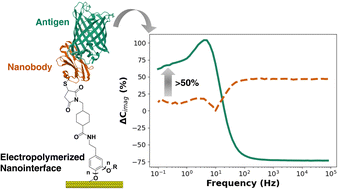
Nanobody-based biosensors promise exceptional molecular recognition and robustness, but their implementation has been limited by unstable and non-scalable surface chemistries. Here we introduce a materials platform that integrates stable electropolymerized tyramine nanofilms with label-free, non-faradaic electrochemical impedance spectroscopy for direct molecular detection. The electropolymerized nanofilms form amine-functionalized coatings that are electrically insulating yet chemically active, supporting site-specific covalent immobilization of nanobodies in controlled orientations. Target binding induces more than a 50% increase in the capacitance signal response, providing a distinct label-free signature of molecular recognition. The platform can be adapted to diverse bioreceptors and antifouling layers, offering a general route to chemically robust and scalable bioelectronic interfaces. By decoupling film conductivity from functional stability, this work establishes a new class of interfaces that bridge molecular design with label-free signal transduction for next-generation biosensing technologies.
 Please wait while we load your content...


