


 PLATFORM UPDATE:


A high-performance photodetector enabled by melamine cation-based lead-free perovskitoid single crystals
 *a
and
Dai-Bin
Kuang
*a
*a
and
Dai-Bin
Kuang
*a
Abstract
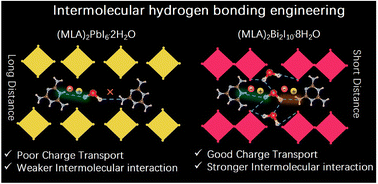
Low-dimensional halide perovskitoids exhibit emerging potential in photodetection owing to their exceptional environmental stability and ultralow dark current. However, their extended inorganic interlayer spacing and weak inter-ligand interactions fundamentally limit their carrier transport efficiency and photodetector performance. In this study, we address the above challenges through melamine (MLA) cation engineering, constructing two isostructural Bi-/Pb-based single crystals [(MLA)2Bi2I10·8H2O (Bi-SC) and (MLA)2PbI6·2H2O (Pb-SC)]. The extensive hydrogen bonds formed by the abundant –NH2/–NH– terminal groups of MLA2+ and water molecules in Bi-SC, as well as the shorter octahedral I⋯I distances (3.83 Å vs. 4.30 Å, a 11% reduction) from Bi3+ substitution, enable lower defect density (4.30 × 10⁹ vs. 3.84 × 1010 cm−3) and higher carrier mobility (4.17 × 10⁻² vs. 3.29 × 10⁻⁴ cm2 s−1 V−1) than those of Pb-SC. As a result, the Bi-SC-based photodetector demonstrates an on/off ratio 15 times higher than that of Pb-SC. Mechanism analysis reveals that the water-bridged hydrogen bonding network simultaneously compresses the inorganic lattice, enhances the stacking arrangement of MLA2+ ligands and thus strengthens charge transfer pathways. The hydrogen-bond engineering overcomes the inherent dimensionality limits in hybrid materials, establishing a general design principle for high-performance low-dimensional optoelectronic applications.
 Please wait while we load your content...


