


 PLATFORM UPDATE:


All-optical tuning of dielectric metasurfaces infiltrated with dye-doped liquid crystals
 *a
Andrey G.
Iljin,
bc
Oleg E.
Kameshkov,
a
Vladlen G.
Shvedov
a
and
Ilya V.
Shadrivov
*a
*a
Andrey G.
Iljin,
bc
Oleg E.
Kameshkov,
a
Vladlen G.
Shvedov
a
and
Ilya V.
Shadrivov
*a
Abstract
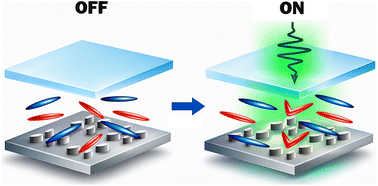
Dielectric metasurfaces with dynamic tunability are critical for advancing ultrathin, multifunctional photonics. Among various strategies for active control, liquid crystals (LCs) are particularly attractive due to their large refractive index modulation and responsiveness to external stimuli. Here, we introduce a powerful all-optical approach for tuning dielectric metasurfaces by leveraging the synergistic interplay between nematic LCs and photoresponsive azo dyes. Using Methyl Red-doped LCs, in situ trans–cis photoisomerization under low-power 532 nm excitation drives local LC reorientation and actively modulates optical anisotropy. This mechanism enables fully reversible, second-scale control of quasi-bound-state resonances in the near-infrared, with a modulation depth exceeding 56%. Importantly, our approach eliminates the need for photoalignment or pre-alignment layers, allowing LC molecules to reorient without surface anchoring constraints. Furthermore, we demonstrate a continuous tuning mechanism by changing the polarization and power of the excitation light, offering a novel degree of metasurface control. By combining fast response, high modulation depth, and complete reversibility without the need for thermal erasure, this platform establishes a new paradigm for reconfigurable photonics. Our results open pathways to next-generation optical switches, dynamic beam shapers, and programmable holographic devices that demand agile, energy-efficient control.
 Please wait while we load your content...


