


 PLATFORM UPDATE:


Highly ordered Pd/CeOx inverse opals for alkaline hydrogen oxidation
 ab
Mathilde
Luneau
*ab
ab
Mathilde
Luneau
*ab
Abstract
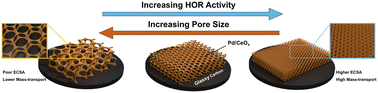
Palladium supported on ceria (Pd/CeOx) has recently emerged as a promising electrocatalyst for the alkaline hydrogen oxidation reaction (HOR) in anion exchange membrane fuel cells. It has been proposed that CeOx provides OH spillover and modulates Pd–H binding, enhancing the reaction kinetics at the key Pd–Ce interface. Herein, we report a method to maximise the Pd–Ce interfacial area by synthesising highly ordered Pd/CeOx inverse opals (IOs) with tunable pore sizes (20–250 nm) directly on glassy carbon electrodes. The resulting IOs exhibit highly ordered pore networks which could be scaled down to the mesoporous regime (<50 nm), and dispersed palladium species, including Pd–O–Ce interfacial sites. Electrochemical measurements reveal a pore size dependence of HOR activity, with IOs fabricated from 104 nm microspheres templates delivering the highest specific activity and strongest enhancement relative to non-templated Pd/CeOx controls. Electrochemically active surface area (ECSA) estimations reveal that larger-pore IOs suffer reduced ECSA likely due to diminished support conductivity associated with thinner ceria interconnections. Increasing the Ce3+ concentration, in an effort to improve conductivity, and increasing relative Pd–O–Ce content do not improve HOR activity, highlighting the need to balance conductivity, Pd and Ce speciation and pore size. The Pd/CeOx IOs remain structurally stable after testing and interestingly, even exhibit improved kinetics after 1000 cycles. This study demonstrates that while the inverse opal architecture is a powerful route to engineer Pd–Ce interfaces, these interfaces are not the only predictor of enhanced HOR. Instead, the inverse opal pore size and interconnect thickness appear to ultimately govern the enhanced HOR kinetics and mass transport. We envision that this fabrication method for inverse opals on complex carbon substrates will allow the design of mesoporous bifunctional catalysts for gas-diffusion electrodes for applications in fuel cells and electrolyzers.
- This article is part of the themed collection: Nanoscale 2026 Emerging Investigators
 Please wait while we load your content...


