


 PLATFORM UPDATE:

Controlled HCl etching of Al2O3 nanoparticles toward void-free interfacial contact for efficient perovskite solar cells
 *b
*b
Abstract
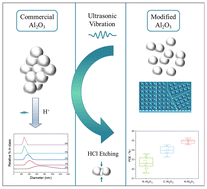
Preferential nucleation at the upper surface of formamidinium–cesium (FA/Cs) perovskite films typically leads to porous structures at the bottom interface. Pre-depositing Al2O3 nanoparticles can enhance nucleation at the bottom interface, thereby suppressing void formation. However, this approach relies heavily on the dispersion behavior of the Al2O3 nanoparticles. Unfortunately, commercial Al2O3 pastes suffer from severe agglomeration. Herein, we report a simple acid-assisted ultrasonication treatment to achieve controllable etching of commercial Al2O3, which significantly improves its dispersibility in solution. This allows the use of a lower Al2O3 concentration to enable compact contact between the FA/Cs perovskite film and the substrate. The reduced amount of Al2O3 not only improves the crystallinity of the perovskite film but also enhances interfacial electron injection. As a result, FA0.95Cs0.05-based perovskite solar cells achieve a power conversion efficiency of 25.28% with a fill factor exceeding 82%. A 16 cm2 mini-module reaches an efficiency of over 22%. Unencapsulated devices retain 90% of their initial efficiency after 1000 h of continuous operation, demonstrating the excellent scalability potential of this approach.
 Please wait while we load your content...


