


 PLATFORM UPDATE:


Minimal water content tailoring of ZrO2 nanocrystals via nonaqueous sol–gel synthesis

Abstract
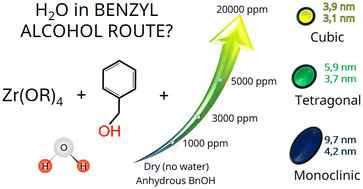
Zirconium dioxide (ZrO2) nanocrystals were synthesized via a nonaqueous sol–gel (NASG) route using zirconium butoxide in benzyl alcohol under solvothermal conditions and high metal alkoxide concentrations. We demonstrate that trace amounts of water, from rigorously dried conditions to the ppm level, play a decisive role in directing crystallization pathways, particle morphology, size, yield, and optical properties. Under strictly anhydrous conditions, elongated monoclinic ZrO2 nanocrystals (>80 wt%) are formed, whereas the controlled introduction of 20 000 ppm water stabilizes nearly spherical cubic ZrO2 nanocrystals without the use of dopants, surfactants, or postsynthetic treatments. Higher water contents induce a partial reversion toward the monoclinic phase, revealing a previously unexplored compositional range for stabilizing the cubic and tetragonal phases of zirconia at high metal precursor concentrations. Crystalline phase characterization was conducted by combining Rietveld-refined X-ray diffraction and Raman spectroscopy, and HRTEM confirmed the distinct size and morphology associated with each polymorph. Beyond phase control, trace water enhances the synthesis yield and tunes the optical band gap. Karl Fischer coulometry further revealed the rapid uptake of atmospheric moisture by benzyl alcohol, establishing a direct link between ambient handling conditions, reproducibility, and nanocrystal design. These findings highlight that at high concentrations of metal alkoxides, even minor water contamination can significantly alter the characteristics of ZrO2 nanocrystals, underscoring the need for rigorous control in nonaqueous sol–gel chemistry.
 Please wait while we load your content...


