


 PLATFORM UPDATE:

Electrostatic potential-tuned d-band center for enhanced oxygen evolution of NiFe-based catalysts
 *abc
*abc
Abstract
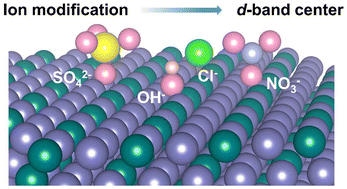
NiFe-based materials are promising, non-precious alternatives to noble metal catalysts for the oxygen evolution reaction. However, their tendency for dynamic surface reconstruction and high oxygen evolution reaction barriers, which arise from challenges in modulating electronic structures, present significant obstacles. Here, using first-principles calculations, we investigate how surface ion modification tunes the electronic structure, particularly by modulating surface electrostatic potential and thereby shifting the d-band center of NiFe alloys to enhance oxygen evolution reaction performance. We reveal that a high d-band center initially drives strong O/OH adsorption and reconstruction, while subsequent O/OH coverage inversely optimizes intermediate adsorption via non-monotonic d-band center shifts caused by competing electron depletion and electrostatic potential renormalization effects. This electronic modulation mechanism is universally validated across diverse ionic systems, confirming the high sensitivity of d-band centers to localized surface atomic configurations. This work elucidates the electronic mechanism of ion modification for precise OER activity control through d-band engineering, establishing a theoretical framework for designing high-performance non-precious metal catalysts.
 Please wait while we load your content...


