


 PLATFORM UPDATE:


Nonlinear generation control with torus metasurfaces

Abstract
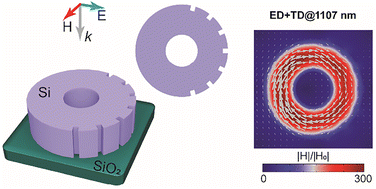
Supporting induced toroidal moments, nanostructures with toroidal topology offer an alternative mechanism for light–matter interaction. Toroidal resonances observed in artificial meta-atoms unambiguously exhibit distinct characteristics originating from their electric and magnetic multipoles. Despite the various nanostructures introduced for toroidal moment excitation, meta-atoms comprising dielectric torus structure, an architecture which naturally provides the topology for toroidal dipole (TD) moments, remain unexplored. On the other hand, the dark-mode nature of resonances in torus metasurfaces enables strong field enhancement and hence the potential for nonlinear optics. Here, third harmonic generation (THG) from planar silicon torus metasurfaces, which support high quality (Q)-factor resonances associated with the bound states in the continuum (BICs) at near-infrared wavelengths, are numerically demonstrated. The properties of the THG signal originating from the electric dipole (ED), TD, magnetic quadrupole (MQ), and magnetic dipole (MD) resonances can be engineered by exploiting the symmetry of the torus nanostructure. A pair of strong chiral resonance modes are observed in the asymmetric resonators with broken in-plane mirror symmetry, enabling elliptically polarized THG signals from the torus metasurfaces under linearly polarized excitations. Dielectric torus metasurfaces supporting quasi-BIC resonances can serve as a powerful platform for light control in both the linear and nonlinear regimes.
 Please wait while we load your content...


