


 PLATFORM UPDATE:


Recent developments and studies on tactile sensor computing

Abstract
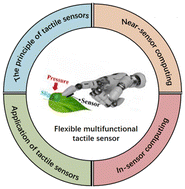
In recent years, with the rapid development of science and technology, tactile sensors, as bridging devices connecting the physical space and the digital world, have played a core supporting role in robotics, healthcare, human–computer interaction, and other fields. However, traditional tactile sensors, characterized by the separation of sensing and computing, are confronted with critical challenges, including high transmission latency, large power consumption, increased system complexity, and severe data and structural redundancy. More importantly, the discrete nature of sensing often leads to the loss of key information, making it difficult for intelligent terminals to meet the requirements of high-performance applications. Given that in-sensor computing and near-sensor computing architectures can effectively shorten data transmission paths and reduce latency and power consumption, research on tactile sensors is evolving towards the integration of perception and computing. This work provides a systematic review of the working principles and frontier research of tactile sensors, with a focus on analyzing the core mechanisms of tactile computing. It compares the working principles, device compositions, performance advantages, and scenario adaptability of near-sensor and in-sensor computing architectures, addressing the lack of systematic integration and analysis of these two architectures in existing studies. Lastly, this work reviews the current challenges facing near-sensor and in-sensor computing and outlines promising avenues for future technological advances, thereby accelerating the intelligent development of tactile sensors with integrated perception and computation.
- This article is part of the themed collections: Recent Review Articles and Nanoscale 2026 Emerging Investigators
 Please wait while we load your content...


