


 PLATFORM UPDATE:


Boosting the NIR-I luminescence of lanthanide nanoparticles excited in NIR-II by plasmonic arrays

Abstract
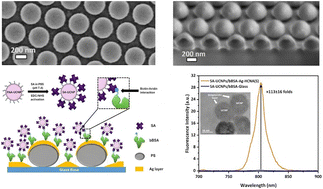
The exploitation of lanthanide-induced NIR luminescence holds significant potential for advancing biosensing and imaging technologies because of its deeper imaging penetration depth and lower biosensing noise than visible light. However, the low quantum efficiency of light generation, along with the high cost and poor sensitivity of light detection for NIR-II photons, have largely constrained the application of NIR-II luminescence for bio-imaging and sensing. To overcome these challenges, we have developed a new strategy for NIR bioimaging and sensing by using Tm3+-doped NaYF4 upconversion nanoparticles (UCNPs) that emit NIR-I upconversion luminescence (UCL) at 808 nm under NIR-II excitation at 1208 nm. The 1208 nm excitation enables deeper imaging penetration due to negligible autofluorescence, thereby reducing biosensing noise, resulting in an enhanced signal-to-noise ratio (S/N) from a minimal noise background. Meanwhile, the NIR-I emission at 808 nm allows deep tissue penetration, while allowing highly sensitive detection of NIR-I photons using conventional detectors, which are much more accessible than NIR-II detection systems. The intrinsically weak NIR UCL signals were further amplified by up to 210-fold using a pioneering plasmonic approach, achieved by coupling UCNPs with periodic silver hole–cap nanoarrays (Ag-HCNAs). Three-dimensional finite-difference time-domain (3D-FDTD) simulations and lifetime analyses revealed substantial electric field enhancements under 1208 nm excitation and accelerated radiative decay at 808 nm, contributing to both excitation and emission enhancement. The potential use of Ag-HCNA–UCNP conjugates for fluorescence immunoassay platforms was further validated by immobilizing streptavidin-functionalized UCNPs (SA-UCNPs) onto biotinylated Bovine Serum Albumin (bBSA) pre-grafted substrates, resulting in up to a 113-fold increase in UCL intensity. This plasmonic-enhanced UCL platform offers significant advantages, including cost-effective detection of 808 nm emission using silicon-based detectors, an improved signal-to-noise ratio through enhanced tissue penetration, and reduced autofluorescence enabled by NIR-II excitation.
 Please wait while we load your content...


