


 PLATFORM UPDATE:


Structurally robust quaterphenyl-dicarbonitrile 2D MOF nanopores on Cu(111) for cobalt spin-coordination motifs

Abstract
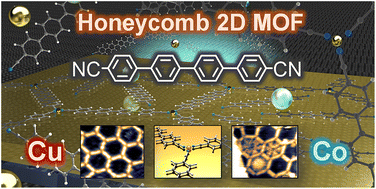
We demonstrate a strategy for fabricating robust ∼2 nm nanopores on copper (Cu) surfaces using a nonmagnetic two-dimensional (2D) metal–organic framework (MOF), without the need for additional 3d metal atom deposition, that serves as a platform for constructing single-atom transition-metal coordination sites. Scanning tunneling microscopy and spectroscopy (STM/STS) conducted at 78 K under ultrahigh vacuum (UHV), along with angle-resolved photoemission spectroscopy (ARPES) at 300 K, provide direct insight into the electronic structure. Machine-learning interatomic potential (MLIP) calculations and density functional theory (DFT) further evaluate the energetic stability of the system. Deposition of the molecular precursor [1,1″:4′,1″:4″,1‴-quaterphenyl]-4,4‴-dicarbonitrile (Ph4DN) onto Cu(111) results in a quasi-honeycomb 2D MOF stabilized by Cu adatoms. In contrast to the analogous MOF on Ag(111), which requires additional 3d metal atom linkers to form a 2D MOF, and where excess 3d atoms beyond the stoichiometric ratio disrupt the MOF's regularity, the Cu-supported MOF remains intact, reflecting stronger MOF-substrate interactions on Cu(111). The reduced mobility of molecular species on Cu(111) leads to the coexistence of 2D MOF, 1D MOF, and self-assembled monolayer domains, with the 2D MOF being the most energetically favorable. Focusing on the electronic structure of the 2D MOF on Cu(111), we show that its nanopores serve as stable confinement sites that can trap conduction electrons, leading to the formation of quantum-well states, while also accommodating additional precursor molecules and Co atoms without forming chemical bonds. These capabilities suggest that the nanopores function as nanoscale reactors capable of assembling diverse coordination motifs. This approach offers a versatile strategy for engineering well-defined nanopores within nonmagnetic 2D MOFs, capable of hosting isolated atoms and molecules, and provides promising opportunities for applications in single-atom electronics, spintronic devices, quantum materials, and catalytic platforms.
- This article is part of the themed collection: Nanoscale Covers
 Please wait while we load your content...


