


Dual-interfacial engineering via LiPF6 treatment: eradicating Li2CO3 on LLZTO and regulating SEI for high-voltage solid-state batteries

Abstract
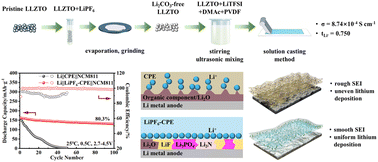
The performance of composite polymer electrolytes (CPEs) in all-solid-state lithium batteries (ASSLBs) is critically limited by two interfacial challenges: incompatibility between ceramic fillers and the polymer matrix, and an unstable solid electrolyte interphase (SEI) against lithium metal. Garnet-type Li6.4La3Zr1.4Ta0.6O12 (LLZTO) is a promising inorganic filler, yet air exposure induces an insulating surface Li2CO3 layer, causing PVDF dehydrofluorination and hindering ion transport. Herein, we developed a facile surface modification strategy using LiPF6 solution treatment. This approach efficiently eliminated Li2CO3 via an acid–base reaction with LiPF6 hydrolysis products, simultaneously in situ generating a Li3PO4-LiF composite coating that compensated for lithium loss. Moreover, this modification modulated the structure and composition of the solid electrolyte interphase (SEI) formed at the electrolyte/lithium metal interface, inducing the formation of a uniform, stable inorganic SEI layer enriched with LiF, Li3PO4, and Li3N. The resulting modified-LLZTO based PVDF CPE (LiPF6-CPE) achieved a high room-temperature ionic conductivity of 8.74 × 10⁻⁴ S cm−1, a Li+ transference number of 0.750, and enabled stable cycling for over 1000 h in a Li symmetric cell with suppressed lithium dendrite growth. When paired with an NCM811 cathode, the solid-state battery delivered a capacity retention of 88.6% after 100 cycles at 0.5 C (2.7–4.3 V) and maintained 80.3% retention at a high voltage of 4.5 V. This efficient and economical interfacial optimization strategy, which synchronously improved filler-polymer compatibility and regulated SEI layer properties, provided a general and practical solution for interface engineering in the fabrication of high-performance PVDF-based CPEs and ASSLBs.
 Please wait while we load your content...


