


 PLATFORM UPDATE:


Evaluating the efficiency of touch-spun scaffolds in producing dense cell cultures for tissue engineering applications
 ab
Mikhail
Parker,
ab
Mohammad
Aghajohari,
ab
Sergei
Makaev,
ab
Nataraja Sekhar
Yadavalli,
c
Sergiy
Minko
*abc
and
Vladimir
Reukov
*a
ab
Mikhail
Parker,
ab
Mohammad
Aghajohari,
ab
Sergei
Makaev,
ab
Nataraja Sekhar
Yadavalli,
c
Sergiy
Minko
*abc
and
Vladimir
Reukov
*a
Abstract
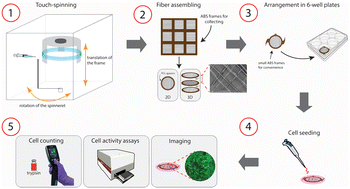
Developing efficient scaffolds for long-term cell cultivation remains a challenge in tissue engineering. Biomimetic approaches aim to create a three-dimensional (3D) extracellular matrix (ECM)-like fiber network with a tunable hierarchical structure to promote sufficient cell attachment, differentiation, and overall viability. Among the fiber fabrication methods documented in the literature, mechanical fiber drawing techniques, such as touch-spinning, have garnered significant research interest. This is due to the simplicity of the equipment, the ability to control fiber diameter and interfiber spacing at the nanoscale without the need for external fields, and the absence of specific requirements for material dielectric properties. Despite the advantages of mechanically drawn scaffolds in biomedical research, the methodologies for cell culturing and analysis for these materials have not been adequately addressed. In this study, we assess the potential of touch-spun scaffolds in promoting NIH/3T3-GFP fibroblast cell growth for tissue engineering applications. Polycaprolactone/polyethylene oxide (PCL/PEO)-based fiber arrays with a controlled interfiber spacing of 91.9 ± 25.0 μm (N = 50) were fabricated using a modified touch-spinning apparatus and then assembled into 2D and 3D scaffolds through additive manufacturing technology. A comparative cell analysis conducted for single- and multi-layered structures showed that the 3D touch-spun scaffolds support healthy growth of up to 6.5 million fibroblast cells within 21 days and offer enhanced cell viability compared to conventional 2D fiber scaffolds, as confirmed by the Presto Blue assay. Furthermore, the metabolic activity of fibroblasts on 3D scaffolds assessed by the MTT test is approximately four times higher than that of the positive control, making the 3D touch-spun materials ideal for long-term cell culture applications.
 Please wait while we load your content...


