


 PLATFORM UPDATE:


Aqueous dispersion of carbon nanotubes by chlorine dioxide oxidation

Abstract
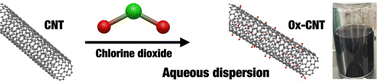
The poor solubility and dispersibility of single-walled carbon nanotubes (SWCNTs) in aqueous media remain critical limitations for their practical application because conventional oxidative treatments typically require harsh conditions that degrade the nanotube structure. Here, we report a simple and scalable method for dispersing SWCNTs in water via chlorine dioxide (ClO2˙)-mediated oxidation under ambient conditions. The treatment selectively introduced oxygenated functionalities—including hydroxy, carbonyl, and carboxy groups—onto the CNT surface while preserving the tubular framework, as confirmed by transmission electron microscopy, Raman spectroscopy, and X-ray photoelectron spectroscopy analyses. The resulting dispersions exhibited long-term colloidal stability without the need for surfactants, supported by a strongly negative ζ potential (−41.6 mV). Importantly, electronic conductivity was largely maintained: the resistivity of oxidized CNT films was only threefold higher than that of sodium cholate–dispersed CNTs (0.045 vs. 0.016 Ω cm at 25 °C), with <10% variation between 25 and 50 °C. This unique balance between enhanced aqueous dispersibility and preserved charge transport underscores ClO2˙ oxidation as a green and effective strategy for producing water-processable CNTs, showing promise for applications in pharmaceutical drugs, printable electronics, functional composites, energy storage, and sensing.
 Please wait while we load your content...


