


Deep oxidation of single-walled carbon nanotubes toward a versatile platform for direct functionalization
 *a
Nikolai I.
Novosadov,
a
Maxim K.
Rabchinskii,
bc
Svetlana I.
Serebrennikova,
d
Dmitry V.
Krasnikov,
d
Ratibor G.
Chumakov,
e
Albert G.
Nasibulin,
d
Roman A.
Novikov
g
and
Valery P.
Melnikov
a
*a
Nikolai I.
Novosadov,
a
Maxim K.
Rabchinskii,
bc
Svetlana I.
Serebrennikova,
d
Dmitry V.
Krasnikov,
d
Ratibor G.
Chumakov,
e
Albert G.
Nasibulin,
d
Roman A.
Novikov
g
and
Valery P.
Melnikov
a
Abstract
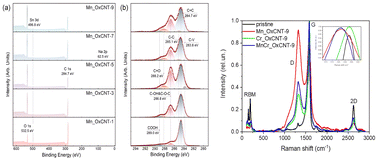
Single-walled carbon nanotubes (SWCNTs) are among the most promising carbon nanomaterials available today. However, in their pristine form, SWCNTs tend to aggregate into bundles, and due to their high aspect ratio, these bundles form highly entangled agglomerates. This aggregation significantly hinders their widespread application across various fields. In this work, we present a method for the deep oxidation of SWCNTs, which enables the production of nanotubes with a high content of hydroxyl, carboxyl, and carbonyl groups. The introduction of these functional groups facilitates the separation of bundles and the deagglomeration of SWCNTs down to individual tubes, all while preserving the original tubular morphology and preventing their transformation into nanoribbons. Moreover, in addition to addressing the challenge of SWCNT agglomeration, we propose the concept of creating a chemical platform based on deeply oxidized SWCNTs for the synthesis of a new class of compounds – directly functionalized SWCNTs bearing various organic groups. This approach paves the way for the development of a wide array of previously unknown functional materials with significant potential for use in diverse devices, ranging from electrochemical energy storage systems and supercapacitors to organic solar cells, spintronic devices, and gas sensing and biosensing systems, including electronic nose technologies.
 Please wait while we load your content...


