


 PLATFORM UPDATE:


Piezo-phototronic flexible photodetectors based on spatially aligned InN nanowires embedded in graphene channel
 a
Jaehyeok
Shin,
a
Sumin
Kang,
a
Yumin
Lee,
a
Jaemin
Lee,
a
Nam-In
Kim,
b
Jae-Hyun
Ryou,
bc
Jin Soo
Kim
*a
a
Jaehyeok
Shin,
a
Sumin
Kang,
a
Yumin
Lee,
a
Jaemin
Lee,
a
Nam-In
Kim,
b
Jae-Hyun
Ryou,
bc
Jin Soo
Kim
*a
Abstract
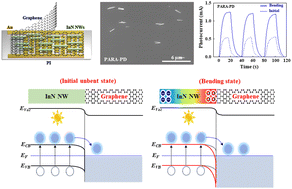
The development of high-performance flexible photodetectors (PDs) is anticipated to provide the necessary variable scalability for emerging light-based technologies such as light detection and ranging, light-fidelity communication, and smart healthcare. Here, we demonstrate highly efficient flexible PDs—based on InN nanowires (NWs) and graphene as the light-absorbing medium and carrier channel, respectively—fabricated on a polyimide substrate to leverage the piezo-phototronic effect for improved device performance. For the PD with randomly distributed NWs (RAND-PD), the photocurrent was increased from 0.58 mA in the initial state to 0.77 mA under bending at a strain level of 2.92% and light intensity of 70 mW cm−2. In contrast, the photocurrent (photoresponsivity) of the PD with spatially aligned InN NWs parallel to the bending direction (PARA-PD) under bending was significantly increased to 1.25 mA (198.4 mA W−1) from 0.55 mA in the initial unbent state. The significantly improved device performance of PARA-PD relative to that of RAND-PD is attributed to the enhanced separation of photo-generated carriers resulting from the piezo-potential induced in the NWs with their spatial alignment along the bending direction in the bent state. In addition, the photocurrent in the devices increases monotonically with the applied strain and the devices are able to operate stably under high humidity and for extended periods of aging. Our findings demonstrate the potential of InN NW/graphene hybrids for high-performance, flexible, and durable PDs purpose-designed for wearable and next-generation optoelectronic applications.
 Please wait while we load your content...


