


 PLATFORM UPDATE:


Aqueous chemistry of MoS2 nanopores: how functional groups influence water permeation and ion/boron rejection
 a
and
Ananth
Govind Rajan
*a
a
and
Ananth
Govind Rajan
*a
Abstract
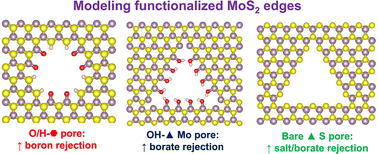
Ultrathin nanoporous membranes based on two-dimensional materials, including molybdenum disulfide (MoS2), offer excellent separation efficiency and chemical stability, making them promising candidates for water purification. Prior molecular dynamics (MD) simulations of MoS2 membranes assumed bare edge structures, neglecting functionalization arising from aqueous environments, due to the lack of suitable classical force fields. Here, we employ quantum-mechanical density functional theory (DFT) to conduct ab initio molecular dynamics simulations that elucidate the interfacial chemistry of MoS2 nanopores in water. Our results reveal a propensity for shape-dependent functionalization at molybdenum (Mo) and sulfur (S) edges of nanopores in MoS2. We observe a pronounced preference in hexagonal pores for hydrogenation (H) at S-terminated edges and oxo (O) functionalization at Mo sites. In contrast, triangular pores with Mo-exposed edges favor hydroxylation (OH), while S-terminated triangular pores remain inert, exhibiting no functionalization. These insights guide the development of accurate, transferable force fields for H-, O-, and OH-functionalized MoS2 nanopores, derived from DFT-computed potential energy surfaces. The resulting models enable stable, chemically realistic MD simulations of molecular and ion transport through MoS2 nanopores harboring various functional groups. Our findings highlight the significant role of edge chemistry in modulating nanoscale transport phenomena. We demonstrate that unfunctionalized S-terminated triangular pores, along with functionalized hexagonal pores, offer high water permeance while maintaining excellent salt and boron rejection, highlighting their potential as promising candidates for selective desalination membranes. Overall, this work offers a robust framework for modeling functionalized MoS2 nanopores in aqueous environments, advancing their application in separation, sensing, and nanofluidic technologies.
 Please wait while we load your content...


