


Humidity sensing characteristics of graphene and MoS2 as well as their heterostructures with different stacking configurations
 a
Xuge
Fan
*abc
a
Xuge
Fan
*abc
Abstract
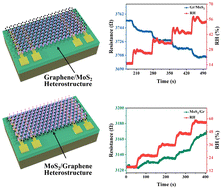
The ultra-high specific surface area of two-dimensional (2D) materials boosts the development of electronic devices based on 2D material films in gas sensing and humidity sensing. Here, we constructed four distinct humidity sensor architectures based on atomically thin graphene and molybdenum disulfide, encompassing monolayer graphene, monolayer MoS2, graphene/MoS2 heterostructure, and reverse-stacked MoS2/graphene heterostructure configurations. We systematically elucidated the evolution of the humidity response characteristics of the above 2D membranes during the transition from individual materials to heterostructures. The results revealed that within the range from 15% RH to 55% RH, the monolayer MoS2-based humidity sensor demonstrated exceptional response characteristics with a remarkable resistance change rate (ΔR/R0) of 271.1%, significantly surpassing the resistance change rates of the humidity sensors based on monolayer graphene (1.98%), graphene/MoS2 heterostructures (1.69%), and MoS2/graphene heterostructures (1.16%). This pronounced performance disparity highlighted the crucial role of two-dimensional material interface engineering in modulating humidity sensing capabilities, providing important theoretical foundations and practical guidance for developing high-performance humidity sensors based on two-dimensional materials.
 Please wait while we load your content...


