


 PLATFORM UPDATE:


Regulating the layered structure of 2D FePS3 to achieve high-performance electrocatalytic urea degradation

Abstract
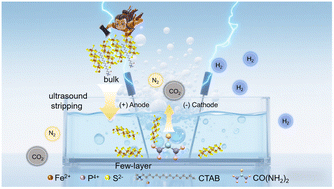
Transition metal phosphorus sulfides, owing to their unique 2D layered structure and inherent cost-effectiveness, have emerged as promising electrocatalysts in the urea oxidation reaction (UOR). However, they encounter a notable challenge that the dense stacking of their layers drastically restricts the exposure of electrochemically active sites and diminishes electron transfer efficiency, thereby directly leading to subpar performance in the UOR. Herein, based on an intercalation–exfoliation method, a novel layer structural regulation strategy for achieving few-layer FePS3 has been proposed. The results demonstrated that the interlayer stacking of pristine FePS3 could be significantly diminished, with the average layer thickness reducing from 25 nm to an impressive 8 nm. Benefiting from the changes in the layer structure, the few-layer FePS3 exhibits excellent UOR activity, requiring only 1.371 V (vs. RHE) to deliver 10 mA cm−2 and maintaining a low potential of 1.545 V at 300 mA cm−2, which is due to the enhanced exposure of electrochemically active sites and the increased electron transfer efficiency. Simultaneously, the mechanism of enhancing the UOR has been elucidated through in situ Raman and XPS studies. When the UOR of the FePS3/NF couples with the HER of Pt to achieve full electrolysis, the few-layer FePS3/NF system could achieve a urea degradation efficiency of 67.88% after 12 hours, significantly exceeding that of the pristine FePS3/NF system (50.3%). Hence, this work presents a novel strategy for regulating the layered structure of 2D FePS3 to fulfil the synergistic demands of highly efficient urea degradation and low-energy H2 production.
 Please wait while we load your content...


