


 PLATFORM UPDATE:

Novel chemical mechanical polishing assisted by photocatalysis and shear-thickening for a free surface blade of a Ti alloy using ceria nano-abrasives
 *a
*a
Abstract
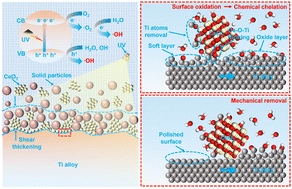
Titanium (Ti) alloys have low thermal conductivity, suffer from tool wear and deformation of workpieces and are difficult-to-machine metals. This contributes to surface roughness, Sa > 240 nm of Ti alloys after mechanical polishing with a low material removal rate (MRR). With the addition of assisting energy fields, the MRR is usually lower than 7 μm h−1. Nevertheless, there is a high demand to achieve Sa < 50 nm on a free surface blade to save energy and reduce the resistance of fluids. To address this challenge, novel photocatalytic shear-thickening chemical mechanical polishing (PSTCMP) was developed using a custom-made polisher. The new PSTCMP slurry contained ceria, corn starch, sodium bicarbonate and deionized water. After PSTCMP, the Sa and thickness of the damaged layer of a free surface blade of a Ti alloy decreased from 501.71 to 38.46 nm and from 634.79 to 7.83 nm, respectively, representing reductions of 92% and 99%. The MRR is 12.52 μm h−1. To the best of our knowledge, both the Sa and MRR are the best published to date for a Ti alloy blade with a free surface. PSTCMP mechanisms were interpreted using first-principles molecular dynamics, X-ray photoelectron spectroscopy and Fourier transform infrared spectroscopy. Hydroxyl radicals were generated under ultraviolet irradiation on ceria with a size of 4.2 nm, oxidizing the surface of the Ti alloy and forming Ti–OH and Ti–O groups. A Ce–O–Ti interface bridge was produced between Ti–OH and Ce–OH, induced by the hydrolysis of ceria. Our findings provide a new way to fabricate nanometer-scale surface roughness on a free surface blade of a Ti alloy with a high MRR.
- This article is part of the themed collection: Nanoscale Covers
 Please wait while we load your content...


