


 PLATFORM UPDATE:


Light-responsive Au/TiO2/PDA coating enhances the antibacterial performance of titanium implants
 ab
ab
Abstract
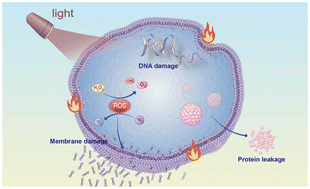
Implant-associated infections represent a leading cause of titanium (Ti) implant failure. The generation of reactive oxygen species (ROS) via photocatalytic materials for treating bacterial infections has garnered significant attention, with titanium dioxide emerging as an exceptional photocatalyst. However, the wide bandgap of this semiconductor limits its application within the ultraviolet range of the spectrum. Herein, we developed a light-responsive antibacterial coating on Ti substrates via dopamine-mediated polymerization, incorporating gold nanoparticles (Au NPs) and titanium dioxide quantum dots (TiO2 QDs), aiming to extend the photocatalytic action of the nanocomposite to the visible and near-infrared ranges. Under simulated solar irradiation (AM 1.5), the Au/TiO2/PDA coating exhibited potent antibacterial performance against both Staphylococcus aureus and Escherichia coli, attributed to the synergistic action of reactive oxygen species (ROS) generation and localized hyperthermia. Moreover, the coating demonstrated excellent biocompatibility. This work presents a facile and scalable surface modification strategy that significantly enhances the antibacterial properties of titanium implants, showing great potential for preventing implant-related infections.
 Please wait while we load your content...


