


 PLATFORM UPDATE:


Hard meets soft: tuning binary ferrofluids
 b
Andrey A.
Kuznetsov,
c
Deniz
Mostarac,
c
Niéli
Daffé,
ade
Marcin
Sikora,
f
Dario
Taverna,
a
Philippe
Sainctavit,
a
Mauro
Rovezzi,
hi
Hebatalla
Elnaggar,
a
Rachid
Belkhou,
e
Claire
Carvallo,
a
Amélie
Juhin
*a
and
Sofia S.
Kantorovich
*c
b
Andrey A.
Kuznetsov,
c
Deniz
Mostarac,
c
Niéli
Daffé,
ade
Marcin
Sikora,
f
Dario
Taverna,
a
Philippe
Sainctavit,
a
Mauro
Rovezzi,
hi
Hebatalla
Elnaggar,
a
Rachid
Belkhou,
e
Claire
Carvallo,
a
Amélie
Juhin
*a
and
Sofia S.
Kantorovich
*c
Abstract
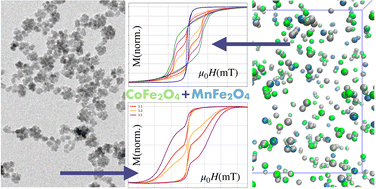
We study binary ferrofluids composed of multicore “nanoflowers” of magnetically hard CoFe2O4 and magnetically soft MnFe2O4, as a way to optimise heat dissipation while suppressing aggregation–properties essential for biomedical applications. Bulk magnetometry and molecular dynamics simulations were combined to elucidate their behaviour. Experiments show wasp-waisted hysteresis, composition-dependent coercivity, and strong protocol dependence (field cooling). Simulations reproduce these trends and reveal the underlying structure–property coupling: (i) in an applied magnetic field, CoFe2O4 forms chains that dominate collective switching; (ii) adding MnFe2O4 “poisons” these chains—shortening and de-branching clusters—thereby lowering coercivity and loop area relative to a weighted superposition of the individual component responses without interactions; (iii) dipolar coupling reciprocally hardens the magnetically soft phase and softens the magnetically hard phase even without large-scale aggregation; and (iv) at higher total volume fraction (ϕ = 0.1) magnetically soft particles still suppress chain growth, reducing mean cluster size by up to an order of magnitude while keeping heating-relevant hysteresis close to Stoner–Wohlfarth expectations. These results establish composition-controlled microstructure as a means to decouple thermal output from aggregation: CoFe2O4 : MnFe2O4 mixtures can be tuned to enhance loss mechanisms while mitigating aggregation, offering a route to binary ferrofluids optimized for magnetic hyperthermia and drug delivery.
- This article is part of the themed collections: Magnetic Nanoparticles: From Massart Method to a Cascade of Innovations and Nanoscale Covers
 Please wait while we load your content...


