


Unveiling the underlying physical mechanisms of inverted perovskite solar cells

Abstract
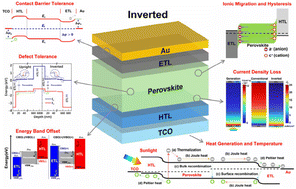
Compared to conventional perovskite solar cells (PSCs), inverted PSCs exhibit considerable potential for commercialization due to their superior stability, efficiency, low hysteresis, and compatibility with tandem devices. However, the physical mechanisms underlying their high efficiency and low hysteresis remain unclear. Experimentally, decoupling synergistic factor effects is challenging, hindering evaluation of key parameters like defect concentration and band alignment. Theoretically, systematic analyses of carrier recombination, electric field distribution, and ion migration in inverted structures are lacking. This study systematically compares carrier dynamics, defect tolerance, band alignment adaptability, and ion migration between inverted and conventional PSCs, revealing key optimization mechanisms. Unlike conventional structures, inverted structures concentrate photogenerated carriers at the perovskite/hole transport layer (HTL) interface, significantly shortening the hole extraction distance. This leads to a 14.5% suppression of nonradiative recombination. Inverted structures also show enhanced defect tolerance and band alignment adaptability. Efficiency increases by 50% at defect concentrations up to 1019 cm−3 and improves 5.1-fold under a valence band offset (VBO) of 0.4 eV. Dynamic ion migration modeling first elucidates the origin of low hysteresis: unique electric field distribution suppresses the anion migration rate by 55.6% and decreases the hysteresis factor by 47%. This work enhances understanding of inverted PSC operation, guiding high-performance device design.
 Please wait while we load your content...


