


 PLATFORM UPDATE:


Corona-dependent enhanced fluorescence response of defects-induced single-walled carbon nanotubes to organophosphate
 *befghi
Abstract
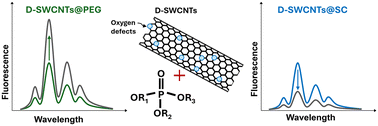
Single-walled carbon nanotubes (SWCNTs) are promising near-infrared (NIR) fluorescent nanomaterials for sensing, where their optical response is governed by surface chemistry and the surrounding corona phase. While defect engineering has been widely employed to tune SWCNT photophysics, it remains unclear how identical defects influence surface reactivity when embedded in different coronas. Addressing this gap is essential for decoupling intrinsic effects of defect introduction from extrinsic contributions of surface passivation. A deeper understanding of this interplay can inform the rational design of nanomaterials with tailored interfacial reactivity. Here, we introduce oxygen defects into (6,5) SWCNTs and demonstrate their enhanced, corona-dependent fluorescence response toward organophosphates (OPs), a model class of reactive small-molecule analytes. In sodium cholate dispersions (SWCNTs@SC), pristine nanotubes exhibit a rapid decrease in fluorescence intensity upon OP addition, whereas defect-induced SWCNTs (D-SWCNTs@SC) show amplified response. In contrast, pristine lipid–polyethylene glycol dispersions (SWCNTs@PEG) show negligible fluorescence modulation, while D-SWCNTs@PEG display a gradual fluorescence enhancement, persisting even in seawater. Fourier transform infrared and high-resolution X-ray photoelectron spectroscopy confirm direct OP-defect interactions in D-SWCNTs@SC and surface passivation in D-SWCNTs@PEG. These findings establish oxygen defects as tunable modulators of SWCNT-analyte interactions in a corona-dependent manner, offering a versatile platform for NIR fluorescence sensing.
 Please wait while we load your content...


