


 PLATFORM UPDATE:


Morphology–phase coevolution driven by oxygen chemical potential in Fe3O4/α-Fe2O3 nanosheets

Abstract
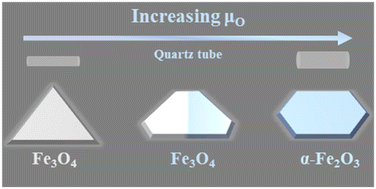
Studies on the morphology and phase of two-dimensional (2D) non-van der Waals iron oxides are often carried out independently, leaving their coupling relationship unexplored. Herein, we report an oxygen-potential-driven chemical vapor deposition (CVD) route that couples morphology control with phase selection in the same system. We vary only the quartz-tube outer diameter to modulate the oxygen flux, which tunes the oxygen chemical potential (μO) without requiring any sophisticated oxygen supplying equipment and transforms the product from magnetite (Fe3O4) to hematite (α-Fe2O3). With increasing μO, Fe3O4 evolves from sharp triangular to truncated triangular nanosheets. However, regular hexagonal α-Fe2O3 nanosheets are obtained above this threshold, indicating morphology–phase coevolution. Opposite curvatures of Fe3O4 {111} A/B edges create a surface chemical-potential difference (Δμ) that drives the evolution into nanosheets bounded solely by A-type edges. DFT calculations show that increasing μO reduces Δμ, enabling the retention of the B edge and yielding truncation. Correlative magnetic imaging further reveals morphology-domain coupling: a vortex state in sharp triangles, a weakened vortex upon truncation, multidomain characteristics when approaching the hexagonal shape, and weak-ferromagnetic α-Fe2O3 with no magnetic phase contrast. This facile regulation method synchronizes phase selection and morphological engineering by regulating μO, laying the groundwork for structure-dependent spintronic device design.
 Please wait while we load your content...


