


 PLATFORM UPDATE:


Electrochemical reduction of oxygen-functional-group-controlled graphene oxide for high carrier mobility

Abstract
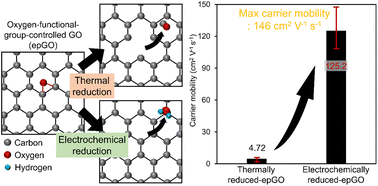
Graphene oxide (GO) contains multiple oxygen functional groups and nano-sized pores that limit the electrical performance of reduced GO (rGO). Here, we elucidate the chemical stability and electrochemical reduction behaviour of an oxygen-functional-group–controlled GO (epGO) with a highly ordered basal plane and without nano-sized pores. The epGO exhibited significantly higher stability than conventional GO (H-GO) prepared by Hummers’ method in both acidic and basic solutions, retaining its uniform C–O–C functionality. XPS and isotope-substituted FT-IR measurements revealed that electrochemical reduction of epGO proceeds predominantly through defect-free pathways that generate C![[double bond, length as m-dash]](https://www.rsc.org/images/entities/char_e001.gif) C bonds with minor formation of C–OH groups. As a result, rGO derived from epGO maintains a well-ordered honeycomb lattice, in contrast to the defect-rich structure produced by conventional methods. These structural advantages enable the electrochemically reduced epGO in acidic solution at room temperature to achieve higher carrier mobilities up to 146 cm2 V−1 s−1, surpassing those previously reported for rGO obtained by thermal reduction at ultra-high temperatures (over 1000 °C). This study strongly demonstrates electrochemical reduction of epGO as an effective, low-energy route for producing high-quality rGO for electronic applications.
C bonds with minor formation of C–OH groups. As a result, rGO derived from epGO maintains a well-ordered honeycomb lattice, in contrast to the defect-rich structure produced by conventional methods. These structural advantages enable the electrochemically reduced epGO in acidic solution at room temperature to achieve higher carrier mobilities up to 146 cm2 V−1 s−1, surpassing those previously reported for rGO obtained by thermal reduction at ultra-high temperatures (over 1000 °C). This study strongly demonstrates electrochemical reduction of epGO as an effective, low-energy route for producing high-quality rGO for electronic applications.
 Please wait while we load your content...


